
Self-employed borrowers in the Richmond, VA area run into a version of mortgage qualification that W-2 employees never see. Instead of a pay stub, you’re handing over two years of tax returns, profit-and-loss statements, and sometimes bank statements, while an underwriter tries to translate fluctuating 1099 or business income into a stable monthly figure for debt-to-income math. Not every lender approaches that translation the same way, and the difference between an overlay that adds back depreciation generously and one that doesn’t can be the difference between an approval and a decline. This comparison looks at five lenders and loan-program approaches that Richmond-area self-employed borrowers, including veterans and small-business owners, are likely to encounter while shopping, so you can see how each one handles documentation, DTI calculation, and program access before you apply.
Quick Comparison
- Richmond Home Loans (Coast2Coast Mortgage): best for self-employed borrowers who want one point of contact with access to multiple wholesale lenders; quote-based; the only option here that can shop a declined file to a different investor’s underwriting guidelines without restarting the process.
- Rocket: best for self-employed borrowers with clean, well-documented tax returns who prefer a digital-first process; quote-based; the only lender on this list built around a fully self-service online application from start to close.
- Veterans United: best for self-employed veterans set on a VA loan; quote-based; the only lender here that works exclusively in VA financing.
- Movement: best for self-employed borrowers who want a multi-program lender with a local branch relationship; quote-based; the only option here built around a community-branch model across several loan programs.
- Cowart Team: best for self-employed borrowers who want a small, consistent team throughout underwriting; quote-based; the only lender here structured around a tight two-person point of contact.
- Parks Mortgage Group: best for self-employed borrowers who prefer an independent, regionally focused shop; quote-based; the only option here positioned as a smaller, regionally focused independent group rather than a branch of a larger brand.
1. Richmond Home Loans (Coast2Coast Mortgage)
Richmond Home Loans is a Richmond, VA-based broker-and-lender team led by Duane Buziak, NMLS #1110647, built around VA, Conventional, FHA, and Jumbo loan programs with a hands-on review of self-employed income before a file ever goes to underwriting. Because the team operates as both a broker and a lender, self-employed applicants get access to hundreds of wholesale lenders rather than a single set of underwriting guidelines.

That distinction matters more for self-employed borrowers than for W-2 applicants. Two lenders can look at the identical tax returns and P&L statement and reach different DTI conclusions depending on how each treats add-backs, income averaging, or business deductions. A broker-and-lender model means a file that doesn’t fit one investor’s overlay can potentially be repositioned with another, without the borrower starting the application over from scratch.
- Access to hundreds of wholesale lenders through a broker-and-lender model, widening the odds of finding an investor whose self-employed guidelines fit your file
- VA, Conventional, FHA, and Jumbo loan programs under one roof, so you’re not screened out before you’ve compared options
- NoTouch Credit Pull soft-pull pre-approval tool, letting you get a read on your position before a hard inquiry hits your credit
- Personalized review of tax returns and P&L statements before submission, catching documentation gaps that commonly trigger conditions or delays
Setup is a direct conversation rather than a self-service portal: a loan officer walks through your tax returns, business structure, and ownership percentage before deciding which program and investor guidelines fit best. The limitation is geographic. The team is primarily licensed in VA, FL, TN, GA, DC, NC, SC, and MD, so it isn’t an option for a self-employed borrower purchasing outside those states. Pricing is quote-based, since rates and terms depend on the loan program, credit profile, and how the borrower’s income is documented.
Best for: Self-employed borrowers in Richmond who want one point of contact with access to multiple lender guidelines rather than a single overlay.
2. Rocket
Rocket is a large national online mortgage lender built around a digital application and document-upload process, covering Conventional, FHA, VA, and Jumbo loan options. For self-employed borrowers, the appeal is speed and convenience: you upload tax returns and supporting documents through the portal instead of scheduling calls.
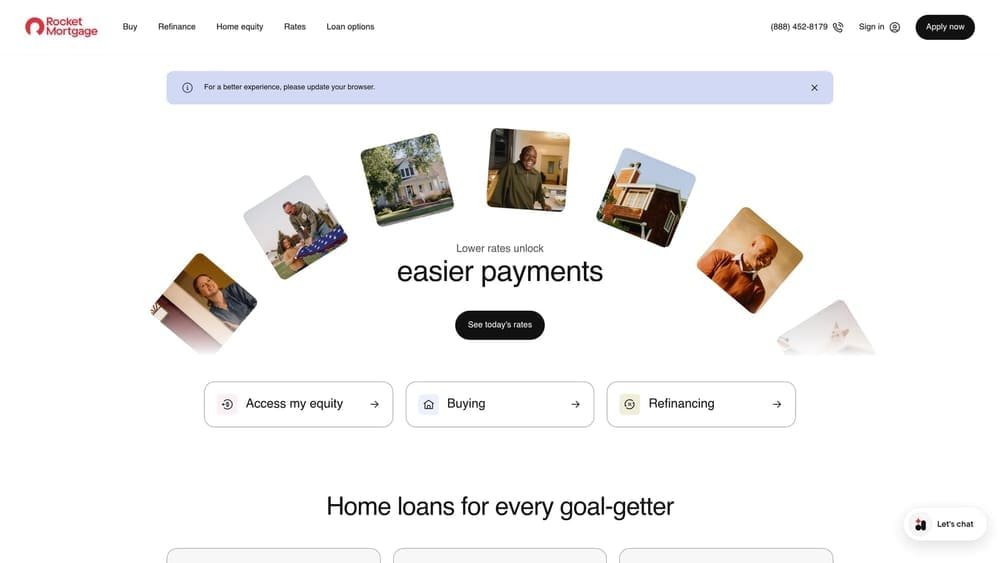
Where Rocket stands apart on this list is its fully self-service model. You can move from application through much of underwriting and closing with minimal phone or in-person contact, using online rate and payment estimator tools to model scenarios yourself.
- Fully digital application and document upload, useful if you’d rather submit tax returns and P&L statements on your own schedule
- Online rate and payment estimator tools, giving you a rough sense of payment scenarios before you commit to an application
- Conventional, FHA, VA, and Jumbo loan options, covering most standard program needs
- Large-scale processing infrastructure built to handle high volumes of applications
The tradeoff for self-employed borrowers is individualized guidance. When your income is straightforward, a digital process works fine. When it isn’t, when you have multiple businesses, recent income drops, or unusual deduction patterns, a self-service platform may not give you the same real-time conversation about how to present your documentation that a dedicated loan officer would. Self-employed applicants with complex files often need someone to walk through choices before submission, not after a condition comes back. Pricing is quote-based and varies by credit profile, loan amount, and program; check the site for current terms.
Best for: Self-employed borrowers with straightforward, well-documented tax returns who prefer a digital-first process over phone-based guidance.
3. Veterans United
Veterans United specializes exclusively in VA home loans, which makes it a relevant option for self-employed veterans and military-affiliated borrowers in the Richmond area who already know they qualify for VA financing. VA loans do allow self-employed income, typically with a two-year self-employment history requirement; current guidance is published at va.gov and is worth reviewing before you apply anywhere.

What sets this lender apart here is depth of specialization rather than breadth. Loan officers who work only in VA financing tend to be well-versed in the specific underwriting nuances that come up for self-employed veterans, particularly those transitioning from active-duty W-2 income to business ownership, where lenders want to see a consistent trend across two years of returns.
- VA-loan-only focus, meaning every process and system is built around one program rather than several
- Loan specialists experienced with military and veteran income documentation, including self-employment transitions
- Educational resources on VA entitlement and eligibility, useful if you’re unsure how much entitlement you have left
- Dedicated VA underwriting teams familiar with Certificate of Eligibility processing and VA-specific DTI guidance
The obvious limitation is program range. This lender does not offer Conventional, FHA, or Jumbo financing, so it isn’t a fit for a self-employed veteran who doesn’t want or doesn’t qualify for a VA loan, or who needs a Jumbo loan above VA limits. If your business income doesn’t yet meet VA’s continuity and history requirements, you’ll need to look elsewhere or wait. Pricing is quote-based; VA loans carry a funding fee that varies by down payment and prior VA loan use, so ask for specifics tied to your file.
Best for: Self-employed veterans who know they want a VA loan and value a VA-only specialist.
4. Movement
Movement offers Conventional, FHA, VA, and other loan programs through a community-based loan officer model, with local branch presence in many markets including parts of the Richmond region. For self-employed borrowers who want to sit across from someone in person while explaining a business structure or unusual deduction, that local footprint has value.

The standout trait compared with the rest of this list is the combination of multi-program access and community positioning. Rather than specializing in one loan type the way Veterans United does, Movement’s loan officers can move a self-employed applicant between Conventional, FHA, and VA options depending on which program’s DTI and documentation rules fit best, while keeping the relationship local.
- Conventional, FHA, VA, and other loan programs, giving self-employed borrowers more than one path to qualification
- Community-based loan officer model, useful for borrowers who want an in-person relationship
- In-person and local branch presence in many markets, reducing reliance on phone or email-only communication
- Educational homebuyer resources that can help first-time self-employed buyers understand the process
Because underwriting overlays and self-employed guidelines can vary by branch and change over time, self-employed applicants should confirm current documentation requirements directly with a local loan officer rather than assuming the same policy applies everywhere. Setup involves a direct conversation with a branch-based officer rather than a purely digital intake. Pricing is quote-based and depends on program, credit profile, and loan amount; ask for current terms before comparing against other quotes.
Best for: Self-employed borrowers who want a multi-program lender with a local branch relationship rather than a purely digital or single-program lender.
5. Cowart Team
Cowart Team is a team-based mortgage group built around hands-on, relationship-driven service, which can matter to a self-employed borrower who wants the same one or two people reviewing their file from application through closing rather than being routed between departments.
Its distinguishing trait is scale, or rather the lack of it in a good way. A small-team structure means fewer handoffs. For a self-employed applicant whose file needs some back-and-forth over how to document a P&L statement or explain an income dip during a slow year, having consistent contact with the same underwriter-facing team can reduce miscommunication.
- Team-based loan officer model that limits the number of people touching your file
- Relationship-driven, hands-on communication style suited to borrowers who want frequent updates
- Multiple loan program access, though current program offerings should be confirmed directly on their site
- Local market focus that can translate into familiarity with Richmond-area purchase timelines and appraisal patterns
The tradeoff is scale. As a smaller operation than a national brand or a broker with wholesale access, program breadth and self-employed-specific underwriting flexibility, such as bank-statement qualification, should be confirmed before you apply rather than assumed. Integrations and technology stack aren’t publicly detailed, so ask directly about their document intake process. Pricing is quote-based; get specifics tied to your loan amount and program before comparing.
Best for: Self-employed borrowers who prioritize a close, small-team relationship over a large national brand.
6. Parks Mortgage Group
Parks Mortgage Group is an independent mortgage shop that emphasizes individualized borrower service across multiple loan program types, positioning itself as an alternative to both large national lenders and single-program specialists.
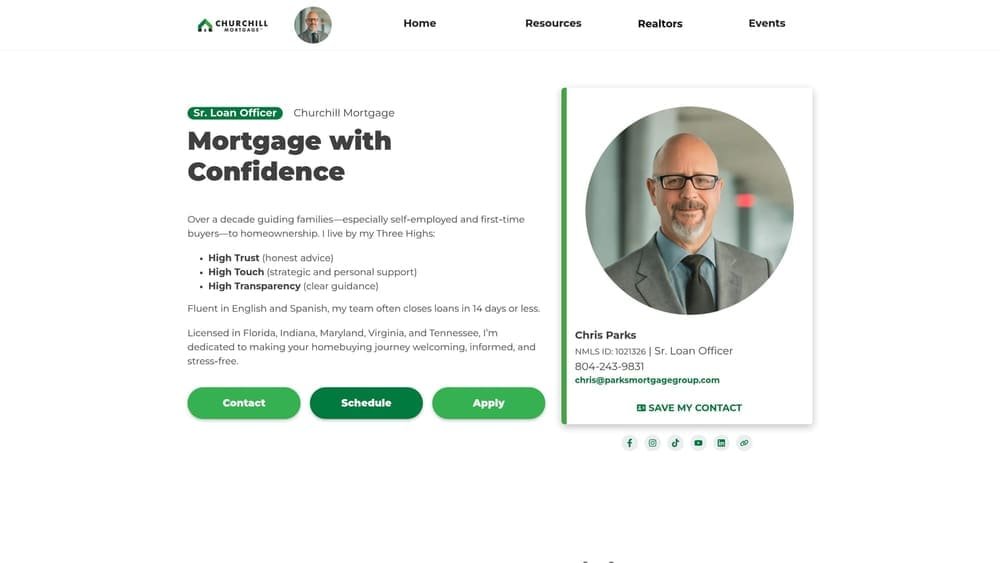
What separates it here is its independent, regionally focused structure, which can translate into more flexibility discussing non-traditional income documentation, bank-statement approaches, or how to present a P&L statement, than a self-employed borrower might get from a large call-center-style lender.
- Independent, regionally focused mortgage shop rather than a branch of a national brand
- Multiple loan program access, with the current lineup best confirmed directly on their site
- Individualized service model built around direct conversations rather than automated routing
- Direct loan officer communication that can help self-employed borrowers work through documentation questions before submission
Because it’s a smaller, independent group, self-employed applicants should ask directly and early about whether bank-statement or P&L-based qualification options are currently available, since program availability shifts over time and isn’t always reflected clearly on a website. Integrations and technology aren’t publicly specified, so plan on a conversation-driven intake process rather than a fully self-service one. Pricing is quote-based and depends on the loan program and borrower profile.
Best for: Self-employed borrowers who prefer a smaller, regionally focused mortgage group over a national brand.
Matching the Right Lender to Your Self-Employment Picture
If you’re a self-employed veteran and you already know a VA loan is the right fit, Veterans United’s exclusive VA focus is worth a serious look, particularly if your business income has a clean two-year trend. If you want the flexibility to shop your file across multiple sets of underwriting guidelines without restarting the process every time one lender’s overlay says no, a broker-and-lender model like Richmond Home Loans is built for exactly that situation, and it’s the one option here that can move a self-employed file between wholesale investors. If your tax returns are clean, consistent, and you’d rather manage the process yourself online, Rocket’s digital-first setup may suit you better than a relationship-driven shop.
Whichever lender you talk to, ask the same three questions: how do they calculate income from your specific tax returns, what add-backs or averaging method do they use, and what happens to your file if it doesn’t fit their standard overlay. As of 2026, documentation requirements and self-employed underwriting flexibility differ by lender and change periodically, so compare current answers directly rather than relying on last year’s guidelines. Duane Buziak, NMLS #1110647, and the Richmond Home Loans team also offer the NoTouch Credit Pull soft-pull pre-approval tool, so you can get a read on your position before deciding which lender’s process fits your file.
Worked Example: Self-Employed DTI on a Richmond-Area Purchase
Suppose a self-employed borrower buying at the Richmond metro’s median sale price shows $9,500 a month in gross self-employed revenue on Schedule C, but after standard business deductions, net income averages $5,200 a month across the two most recent tax years, per underwriting’s income-averaging method. Using a common add-back for depreciation of $300 a month, qualifying income comes to $5,500 a month. On a $410,000 purchase price with 5% down ($20,500), a loan amount near $389,500 at a fully amortizing 30-year term, including estimated taxes and insurance, might run roughly $2,950 a month in principal, interest, taxes, and insurance. Add $650 in existing monthly debts (a car payment and minimum credit card payments), and total monthly obligations reach about $3,600. Divided by $5,500 in qualifying income, that’s a DTI near 65%, which is well above what most conventional guidelines allow.
Now compare that to a lender that recognizes a stronger add-back package, say $500 a month in depreciation plus a one-time non-recurring business expense the borrower can document, pushing qualifying income to $6,000 a month. The same $3,600 in obligations against $6,000 in income brings DTI down to 60%, still high but closer to what certain Conventional or FHA overlays, and some VA files with residual income offsets, may tolerate. That swing, driven entirely by how one underwriter treats add-backs versus another, illustrates why shopping self-employed income across more than one lender’s guidelines can change the outcome without changing a single number on your tax return.
Comparing Documentation and DTI Treatment by Loan Program
| Loan Program | Typical Self-Employment History Required | Income Documentation | DTI Flexibility |
|---|---|---|---|
| VA Loan | 2 years, per current VA guidance | 2 years tax returns, YTD P&L, business license if applicable | Often more flexible with residual income offsets |
| Conventional | 2 years typically | 2 years tax returns, YTD P&L, business bank statements as requested | Standard DTI ceilings, limited overlay flexibility |
| FHA | 2 years typically | 2 years tax returns, YTD P&L, evidence of business existence | Some added flexibility with compensating factors |
| Bank-Statement Program (where offered) | Varies by lender, often 12-24 months of statements | Personal or business bank statements instead of tax returns | Varies significantly by lender; confirm availability directly |
Guidelines above are general and change over time; confirm current requirements with each lender and cross-check against published standards from the Consumer Financial Protection Bureau and HUD.
Frequently Asked Questions
What counts as self-employed income for a mortgage? Most lenders consider you self-employed if you own 25% or more of a business, so both sole proprietors and partial business owners typically fall under self-employed documentation rules.
How many years of tax returns do self-employed borrowers need? Most Conventional, FHA, and VA guidelines call for two years of personal and business tax returns to establish an income trend.
Do lenders use gross or net income for self-employed borrowers? Lenders generally start with net income after deductions, then apply add-backs like depreciation to arrive at qualifying income.
Can self-employed veterans still get a VA loan? Yes, VA loans allow self-employed income with a typical two-year self-employment history; check current guidance at va.gov before applying.
What is a bank-statement loan? It’s a loan program that uses personal or business bank deposits instead of tax returns to document income, offered by some lenders for self-employed borrowers with strong cash flow but complex tax filings.
Why did one lender decline a self-employed application that another approved? Underwriting overlays vary, so one lender’s treatment of add-backs, income averaging, or DTI ceilings can differ enough from another’s to change the outcome on the same file.
Should self-employed borrowers get pre-approved before shopping for a home? Yes, pre-approval, including a soft-pull option like NoTouch Credit Pull, helps confirm qualifying income and DTI before you’re under contract and facing deadlines.
What is a profit-and-loss statement in a mortgage application? A P&L statement is a year-to-date summary of business income and expenses that lenders use alongside tax returns to confirm your income trend is still current.
This information is not intended to be an indication of loan qualification, loan approval or commitment to lend.
Duane Buziak, Mortgage Maestro, NMLS #1110647, is a UWM PRO ELITE 2025 recipient, Scotsman Guide Top Originator for 2025 and 2026, VA Broker of the Year 2024-2025, and ranks in the Top 1% Nationwide, with Coast2Coast Mortgage LLC, NMLS #376205. You can verify licensing information through NMLS Consumer Access.
Whether you’re a veteran ready to use your hard-earned benefits or a homebuyer exploring your financing options, your path to homeownership starts with expert guidance you can trust. Connect with Duane today for a personalized consultation and discover the mortgage solution tailored to your unique goals in the Stafford County and Richmond area.
2 Responses